environmentalresearchweb blog
« Coal clean-up goes underground | Main | Europe’s Aurora - a dreamboat for drilling in the cold »
Reporting climate fuzziness - the wheel of fortune
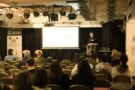
Earlier in the week delegates at the EGU Meeting in Vienna heard Ray Bates call for climate scientists to define what they mean by climate feedback more precisely. Yesterday, Caitlin Buck of the University of Sheffield, UK, stressed the importance of detailing the uncertainty in climate change. Speaking at a press briefing in advance of two conference sessions on the topic, Buck explained how she believes that seeking single number estimates for future climate, for example the temperature in July in Austria in 2100, is unhelpful and not sensible.
“All pieces in the jigsaw are themselves uncertain,” she said. “We should quantify those uncertainties and present them in easy ways. If we don’t keep track of the uncertainty, we’re losing the fuzziness at the edge of the information. At each step of the way we are losing the most extreme things that might happen and those are the things we really want to know about to help us make good decisions.”
Rather than a single number for the “most likely” predicted temperature change by 2100, Buck would like to see scientists using bar charts of temperature change versus probability when they present their results to policymakers and the public.
At the same briefing, Ron Prinn of MIT explained how he has used a “wheel of fortune” approach to communicate to members of the US Congress the link between emissions cuts and the odds of different amounts of temperature rise. He drew up a separate wheel for each emissions cuts policy; the wheel was divided into temperature rise segments whose size was related to their relative probability of occurring. For example, a wheel for a “business as usual” scenario had much larger segments for the higher temperature rises than the wheel for a policy of stringent emissions cuts. “This shows the value of the policy even if there’s lots of uncertainty in the data,” he said.
TrackBack
TrackBack URL for this entry:
http://www.iop.org/mt4/mt-tb.cgi/3025