Skip to the content

IOP A community website from IOP Publishing

environmentalresearchweb blog

« The Algebra of Algae … to Biodiesel | Main | Offshore wind grids: Share or compete? »

AAR? Decoding the glaciobabble

Like all specialists, glaciologists are fond of acronyms and need to be reminded not to use them if they want to be understood by normal people. I don’t know why acronyms exert such power over the modern mind. It has to be more than laziness. Perhaps it is the way the string of letters squeezes such a lot of concept into such a small space.

If you are a normal person who would like some clues to the decoding of glaciobabble, two acronyms stand out. One is ELA, short for equilibrium line altitude. The one I would like to focus on here, though, is AAR, which is short for accumulation-area ratio and is a close relative of ELA.

Two recent studies by Dave Bahr, Mark Dyurgerov and Mark Meier illustrate nicely why the AAR is a powerful concept. The first, with Bahr as first author, appeared in Geophysical Research Letters, and the other, with Dyurgerov as first author, will appear shortly in Journal of Glaciology.

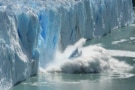
Glaciers are moving bodies of ice on the Earth’s surface. Ice, being near or at its melting point, is a soft solid, and flows from where there is net accumulation, usually at higher altitude, to where there is net loss due to melting or calving or both, usually at lower altitude. (Calving glaciers, however, are special cases, not considered here.)

The ELA is the altitude separating net gain above from net loss below. The AAR is the extent of the upper or accumulation area, above the ELA, divided by the total extent of the glacier.

There are some important ideas squeezed into these acronyms. First, the glacier is a whole. You must consider the accumulation area and the ablation area (the area of net loss) together. Next, the size of the whole depends on the shape. For the glacier to be in balance, neither growing nor shrinking in an unchanging climate, there has to be a balance between the accumulation area and the ablation area.

If nothing happens to alter the balance between gain and loss, the ice flow adjusts matters until a particular, equilibrium AAR is attained. At typical speeds of flow, a glacier somewhat out of balance will need from a few years to a few centuries to reach equilibrium.

The authors’ best estimate of the equilibrium AAR is about 58 percent (give or take 1). Earlier estimates were larger. This finding comes from well-studied glaciers for which the authors plot annual averages of measured AAR against measured mass balance. They get a cloud of dots that defines a clear straight-line relationship. The equilibrium AAR is the AAR at which this line crosses the line representing zero mass balance.

The Dyurgerov study makes it clear that the AARs actually measured over recent decades are well below 58. The average for 1997 to 2006 is 44, give or take 2. Today’s accumulation areas are too small, and today’s glaciers too big, for today’s climate, consistent with today’s mass balances nearly always being negative.

The argument which follows from this finding rests mainly on an earlier demonstration that glacier volume is related to glacier area. Given current total area and AAR, we can estimate the change in volume required to reach the equilibrium total area and its AAR of 58. The authors find that to get to equilibrium with today’s climate the glaciers will have to shed meltwater equivalent to 184±33 millimetres of sea-level rise. That would require somehow stopping climatic change in its tracks. But if we carry on with business as usual, the loss over the next hundred years comes out at 373±21 mm, or 3.7 mm/yr. The recent rate of mass loss is near to 1.3 mm/yr.

The upshot of all this is a new twist on the notion of committed change. Just as we will have to live with the greenhouse gases we have already added to the atmosphere, so we will have to watch our glaciers melt away - no matter what we do.

TrackBack

TrackBack URL for this entry:
http://www.iop.org/mt4/mt-tb.cgi/3153