Skip to the content

IOP A community website from IOP Publishing

environmentalresearchweb blog

« Climate change to hit energy projects? | Main | The spirit of Waxman-Markey »

Glaciers Online

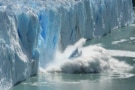
One of the truths about field work on glaciers is that most of the time the weather is rotten, even in summer, when most field work is done. But every so often the clouds lift and even disappear altogether. Whether or not the temperature goes up on one of those infrequent sunny days, the view makes up for all the sleet, wind and fog that represent the norm, and the field workers get out their cameras. The remote-sensing specialists are also grateful for these cloud-free days, because they make air photography and satellite imaging possible.

The outcome of all this fair-weather photographic activity is pretty spectacular, and much of the best work has found its way onto the internet. Here are a few of my favourite places in cyberspace for pictures of glaciers.

Glaciers Online is a web site maintained by Jürg Alean and Michael Hambrey. Jürg Alean is a Swiss teacher who studied Baby Glacier on Axel Heiberg Island, northern Canada, as an M.Sc. student. Baby Glacier is a glacier in which my university, Trent University, has a special interest, and we were fortunate to be able to arrange a return visit to Axel Heiberg Island for Alean in summer 2008. You can see the results at Glaciers Online.

Alean has translated his prowess with the camera into a distinguished career showing the world what glaciers look like. Together, he and Hambrey, a structural glaciologist (among other things) at Aberystwyth University, have published the magnificently illustrated Glaciers (2004, Cambridge University Press). Many of the illustrations are posted at Glaciers Online.

Much of the photoglaciology on the web has a flavour about it of Last Chance to See, Douglas Adams and Mark Carwardine’s 1990 book about filming animals that are on the verge of extinction. All of the glaciers, almost without exception, are getting smaller, and if you return to a place from which somebody photographed a glacier several decades ago there is an increasing chance that there won’t be any ice left to see. Al Gore exploited this plain fact in the award-winning An Inconvenient Truth . At OceanAlaska Kenai Fjords, Bruce Molnia, of the United States Geological Survey, uses the technique of morphing - animating a transition between before and after images - to impressive effect to show what has been happening to the glaciers of the Kenai Mountains in southern Alaska. Most are much smaller now than they used to be.

Molnia is also the author of Glaciers of Alaska, chapter 1386-K in the Satellite Image Atlas of Glaciers of the World, which has been appearing since the 1970s as U.S. Geological Survey Professional Paper 1386. Chapter K, like the Satellite Image Atlas as a whole, is a tour de force in the patient assembly of scattered information about some well-known and a great many almost unknown glaciers.

I have to say, though, that the U.S. Geological Survey’s idea of a “chapter” is not well aligned with mine. I don’t know how much chapter 1386-K weighs because I only have it as a 90-MByte PDF file, but chapter 1386-J, Glaciers of North America (excluding Alaska), weighs 1.6 kg according to the scales in our kitchen. Most of the chapters that have appeared so far are gorgeous.

Finally, back briefly to Gutenberg space. Three visually stunning books about glaciers, not available electronically as far as I know, are Glacier Ice by Austin Post and Ed LaChapelle (revised edition, 2000, University of Washington Press, Seattle); The Opening of a New Landscape: Columbia Glacier at Mid-retreat by Tad Pfeffer (American Geophysical Union, 2007); and Glaciologi by Per Holmlund and Peter Jansson (Stockholm University, 2002). If you are looking for visual delight, then like me you will not mind if you are unable to read the Swedish text of the latter.

TrackBack

TrackBack URL for this entry:
http://www.iop.org/mt4/mt-tb.cgi/3209

Post a comment
Your comments