environmentalresearchweb blog
« The Future of Arctic Sea Ice | Main | Wind, birds and bats »
PDFs, Fat Tails and Collapsing Ice Sheets
Sorry for yet another acronym, and sorrier still that the odds are against your guessing correctly what it stands for. No, it is not a file in Portable Document Format, nor yet a Post-Doctoral Fellow, but a Probability Distribution Function. These PDFs are an essential tool in modern efforts to grapple with environmental risk, uncertainty and just plain ignorance.
Suppose you knocked on a lot of doors, asking to measure the height of the person answering the door. (This is just a thought experiment. Actually doing it would not be a good idea.) At each door you would have a fair chance of getting a measurement equal to the average height of the human population. In fact, averaging your large sample of heights would be the best way to estimate that height, but the sample would also tell you a lot about how often different actual heights crop up. Once in a while the door would be opened by a dwarf or a giant, but the odds are in favour of the person who opens the door being average.
That is the essence of a probability distribution function. The PDF is just the frequency with which anything that varies is spread across the range of its possible values. The idea works just the same for the outcomes of climate model runs as for measured human heights.
We know, from previous large samples, that the PDF of human height is symmetrical. Short people are less likely than average people, and so - with about the same odds - are tall people. This is not true of climate model runs. Their PDFs have fat tails.
All credible climate models predict warming over the next century. The most common outcomes are those in which, by the time the carbon dioxide concentration reaches twice the value it had in about 1850, the temperature will have risen by between 2.0 and 4.5 °C.
The snag is that “most common” is not the same as “average”. A rather small proportion of the model runs predict much greater warming than do the commonest ones, and there is no compensating fatness of frequency on the less-warming side. The average of the predictions is noticeably warmer than the commonest prediction.
How do we respond to this undoubted, unpleasant fact? It is telling us something about the real climate of the future, but in an unsatisfactory way. I think that it is at least a guide to right action. There are actions that will make an improbable catastrophe even more improbable, and if we would not be unhappy with either their costs or their benefits then these actions become more apparently prudent. Policies founded on this reasoning are called “no-regrets policies”. We probably need more of them.
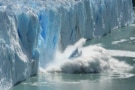
This is supposed to be a blog about glaciology, and I haven’t yet said anything about glaciers. Well, consider the West Antarctic Ice Sheet. Most of it is grounded below sea level, and there is a chance that continued warming will cause it to drain catastrophically into the ocean, starting perhaps in the next hundred years. Our best understanding is that not only is this chance extremely slim but also it would take several hundred years for the catastrophe to play out. But we cannot be certain on either of these points, or on whether the other tail of the PDF (ice-sheet growth because of increased snowfall in a warmer world) is equally probable.
In fact, we glaciologists are so far behind the climatologists that we haven’t even got a PDF yet. One course of right action is therefore obvious: study the problem intensively. The PDF either will or will not turn out to be fat-tailed, and if it is fat it will be either because of physics or because of ignorance. The first exploratory efforts to model the vulnerability of ice sheets are just beginning to appear, and the rush is on to be able to say something quantitative about the likelihood of ice-sheet collapse in time for the next major assessment by the Intergovernmental Panel on Climate Change, due in 2014. At the moment, though, all we can say is “Watch this space”.
TrackBack
TrackBack URL for this entry:
http://www.iop.org/mt4/mt-tb.cgi/3296

Comments (5)