Skip to the content

IOP A community website from IOP Publishing

environmentalresearchweb blog

« Net energy, bank reserve ratio, and jobs | Main | Underground energy »

Death and glaciers

When I was starting my PhD, I met Fritz Müller. He had no stake in my studies, but he insisted on being taken to my field site and delivering a string of inspirational remarks that helped me through the following few years. He was a man of boundless energy and foresight, gifted with the rare ability to make others do what he wanted them to do without them minding (at least, most of them). I keep finding that ideas that come into my head were actually in Fritz Müller’s head several decades ago, and it is a tragedy for glaciology that one day in 1980, when he was conducting an excursion for journalists on Rhone Glacier in Switzerland, he felt unwell, sat down and died of a heart attack.

Fritz’s wife Barbara suffered the compound tragedy of being widowed by the ice twice. Her first husband, the glacial geomorphologist Ben Battle, was drowned in a meltwater stream on Baffin Island in 1953.

Alfred Wegener may be the best known of all victims of the ice because of his arguments for continental drift, first advanced in 1912. Like Fritz Müller, he was decades ahead of his time, but what many do not realize is that Wegener was actually a meteorologist and glaciologist. Some of his measurements of snow accumulation on the Greenland Ice Sheet are still part of standard compilations. In October 1930, having resupplied the forward camp of his meteorological expedition at Eismitte, near the centre of the ice sheet, he and Rasmus Villumsen began the return journey by dog sled to the western margin of the ice. Villumsen was never seen again, but Wegener’s body was found the following May. He seems to have died of overexertion and heart failure.

Perhaps Robert Scott is even better known than Wegener. The staggering story of his 1911–1912 trek to the South Pole, which he reached five weeks later than Roald Amundsen, has been retold times without number. The most recent retelling, Susan Solomon’s The Coldest March (Yale University Press, 2001), may well be the best, and not just for the way it sets out the heroism, fading into fatalism, of Scott and his companions. It also offers insight into the role in Scott’s tragedy of unusually cold weather, and of some of the physiological implications of low temperature that are not fully understood even today.

Amundsen’s journey to and from the South Pole was rather uneventful, but he too died on the ice, in this case the sea ice of the north Atlantic, into which his seaplane is believed to have plunged in 1928 while he was searching for Umberto Nobile. Nobile had flown an airship to the North Pole, but it crashed north of Svalbard on the return flight. Amundsen and his crew joined several of Nobile’s crew on the list of fatalities. Nobile himself, and most of his crew, were fortunately found and rescued, not without further loss among the search parties, and Nobile died at an advanced age in 1978.

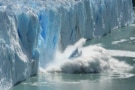
One of the lessons we learn from these famous fatalities is that your physical condition can have a lot to do with whether you come back alive. Setting out in good health, and in company, and equipped with ways of keeping warm, dry and well-fed, are necessities of safe travel on the ice. But the glacier itself can strike at you without warning. The annual toll taken worldwide by crevasses, avalanches and meltwater is difficult to determine because nobody keeps a centralized record, but deaths on glaciers are reported regularly in the media. You don’t have to be famous to fall a victim to the ice.

All of the deaths are tragedies, but many were avoidable. We have learned a lot from the sacrifices of the explorers, and it is a shame that we continue to repeat some of their mistakes. Andy Selters’ Glacier Travel and Crevasse Rescue (The Mountaineers Books, 1999), and the freely-available manual compiled by Georg Kaser, Andrew Fountain and Peter Jansson (UNESCO, 2003; 3 megabytes), are two among many sources for an understanding of how to come back from the glacier alive.

TrackBack

TrackBack URL for this entry:
http://www.iop.org/mt4/mt-tb.cgi/3395

Post a comment
Your comments