Skip to the content

IOP A community website from IOP Publishing

environmentalresearchweb blog

« The Chinese economics of renewable-energy supply | Main | Wind-turbine noise impacts »

Glaciers and global warming

It seems that if you want a bunch of comments about your blog you have to say something controversial. At least, that is what happened to this blog last week. I hope that we can get back sooner rather than later to tranquil consideration of the pleasures of studying glaciers, but in response to some of the comments there is more to be said about “denialists”.

I will stick with that term, which some do not like, because it emphasizes a valuable distinction between denial and doubt. I was not talking about doubters, and in fact as an antidote to breach of trust I have lately been plugging the wisdom of Bertrand Russell as encapsulated in his first commandment: “Do not feel absolutely certain of anything”. There is a world of difference between denial on the one hand and healthy scepticism, or even just asking questions because you don’t know what to think, on the other.

There is also a world of difference between genuine ignorance and culpable ignorance. It is a capital mistake to suppose that I know a lot more than you do. I remember a long-ago field trip to look at glacial sediments during which we managed to get, er, lost. I was sitting at the front of the bus and by a fluke managed to get us unlost. One of the students said “How did you do that?!”, at which point the bus driver interjected”: “That’s why you’re a student and he’s a professor.” True, but superficial. There is an infinity of subjects about which I am genuinely ignorant.

I do know a superficially greater amount about glaciers than you (probably), which is why I am the blogger and you are the reader, but that is not important. One of the points I tried to make last time was that the denialists who commented on the news stories about the Himalayan-glacier fiasco are culpably ignorant.

I admit that “trust me, I’m a scientist” makes a lousy sales pitch, but nearly all of the denialist comments that I was deploring boil down to “trust me, even though I’m a dope”. Seen from one angle, what I have just put down is a terrible thing for a scientist and university professor to say. It is rude and probably hurtful. It breaks elementary rules about how to make conversations work. (Don’t rile your adversary. Give him a way out.) So it cannot possibly advance the discussion. Or can it? I have been worrying a good deal about this recently.

First of all, I am not selling anything. My scientific contributions about glaciers are just contributions, aimed at pushing the frontier of knowledge and understanding forward by a little bit. They are intended to be read critically and accepted or rejected according to the best judgement of the reader. Second, and more fundamentally, there is an awkward attribute of “trust me, even though I’m a dope” that I can’t shake out of my mind, namely that whether or not it is helpful or kind or sensible it is a true paraphrase of the denialist comments.

To put it as diplomatically as I can, there is a problem at the core of the debate about climatic change, and the problem is the uniformly low calibre of the arguments on one side. The arguments on the other side vary from pretty good to compelling. There are loopy environmentalists, of course, but none of them contributed to the newspaper discussions I am talking about. I don’t know how to solve this problem, but winking at it doesn’t make it go away.

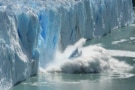
One thing about glaciers that doesn’t get a lot of attention is that they are independent indicators of the state of the atmosphere. The river of reasoning has the spectral absorption bands of carbon dioxide at one of its sources, but further downstream it is braided. The information from weather stations is one of the channels, but the information from glaciers is a different channel. Even if, against all probability, the denialists were to succeed in knocking out my colleagues at the Climatic Research Unit at the University of East Anglia, they would still have succeeded at most in blocking one of the channels temporarily. The carbon dioxide molecules would still be absorbing and re-emitting infrared radiation. The consequent feedbacks would still be at work. The atmosphere would still be getting warmer. Most awkwardly for the denialist cause, the glaciers would still be shedding mass at an accelerating rate.

If you forget for a moment about the weather-station channel and about the carbon dioxide molecules at the headwaters of the stream, and try to explain why the glaciers are shrinking, and shrinking faster now than formerly, you come up against the considered judgement of the scientific community. Science has agreed that you can’t answer these questions satisfactorily if you forget about the carbon dioxide molecules. And even if you persist in forgetting, you still have no coherent basis for tackling the question “What should we do about this?”. The denialist answer is “nothing”, but that brings me to my last point.

I want to emphasize that my comment-eliciting remarks last time were a direct criticism of those members of the public who can be described accurately as denialist, as opposed to sceptical or doubting. I haven’t got a satisfactory answer for Clif Carl’s poser about how to have his doubts addressed or for Steve Carson’s thoughtful analysis of how best to bring travellers back from the borders of denial. I am not attacking the shadowy “vested interests” that are often blamed for climatic misinformation. Nor am I saying that the denialist citizens who comment on the newspaper articles are the dupes or stooges of these vested interests – which would be truly insulting. I am saying that we have to do something about improving the calibre of the debate, and I have no idea what. When it comes to the study of how the public makes up its mind, I am just another member of the public.

What I am saying seems to lead us to the absurdity of requiring ordinary citizens to spend their evenings and weekends boning up on glaciology, spectroscopy and a long list of other special subjects. The alternative seems to be for them to trust somebody, to which, as we have seen, there are objections. That is why I prefer to write about jam jars, baskets of eggs, fiords that turn out to be astonishing and stuff like that. Boning up on glaciers can be a lot more fun than it sounds like.

TrackBack

TrackBack URL for this entry:
http://www.iop.org/mt4/mt-tb.cgi/3569

Comments (3)

  • 1 Andrew Kennett February 4, 2010 3:03 AM

    Graham -- how can I say this diplomatically sadly you just don't seem capable of understanding your own problem. Maybe some of the culpable ignorance you see can be found in you. Any questions or different interpertations are called out as denying, sure you'll artfully add a couple of outs for yourself but in general you don't listen, any behaviour of those who agree with you is excused and any questions are dismissed. It is very sad.

  • 2 Andrew Zolnai February 4, 2010 9:21 AM

    Having lived most of my adult life in North America, I can only echo what de Gaule told Churchill on Nazi vs. Imperial Germany, “the more things change the more they’re the same”. The same way evolution is still hotly debated in the US as theory-not-fact (http://bit.ly/cmJlnu), you compare & contrast denial & doubt. Indeed global warming is a measurable trend not a hard&fast fact (http://bit.ly/b2mcMT). Having settled in Cambridge UK, what a singular contrast among UEA emails' political football, and Cambridge's 800 years of academic excellence. Life goes on.

  • 3 Dan Staley February 7, 2010 10:20 PM

    The good thing is there is only a small number of denialists - too small to be a majority on anything (~10-12% according to reliable work such as the Six Americas study. That is why, in America, they are finally seen as a minority now, and ignored in policy circles. That is why we are finally seeing so much legislation moving forward.

Post a comment
Your comments